Learning how to buy diamond stud earrings is mostly a matter of getting four small decisions right: size, stone quality, how the diamond is held, and how it fastens to the ear. A stud is the most worn piece of jewelry most people own — it goes on in the morning and stays through the day — so the choices that matter are the quiet, practical ones, not the dramatic ones. This guide walks through each in turn, and is written for a first purchase, whether for yourself or as a gift.
A word on what a diamond stud actually is. Two matched stones, one per ear, each set in a small mount on a post that passes through the lobe and is secured behind. That is the whole object. Because there is so little metal and no surrounding design to distract the eye, the diamond does all the work — which is precisely why the small specifications repay a little attention.
How to buy diamond stud earrings: what carat for everyday wear
The most common question is what carat for stud earrings, and the honest answer is that it is measured per ear, then doubled. A "1 carat" pair usually means one carat total weight — roughly half a carat in each ear. This matters when you compare descriptions, because a "1 ct each" pair and a "1 ct total" pair look quite different on the lobe and are priced accordingly.
For daily wear, smaller reads as more versatile, not less valuable. A modest pair sits flat, catches light without announcing itself, and suits an office, a school run, and dinner equally. Larger stones make a clearer statement and a heavier earring, which some lobes feel by evening. As a rough orientation for a round brilliant:
Round stud sizing, per ear
- 0.25 ct each (≈0.50 tw)
- ≈4.1 mm · discreet, true everyday, very light on the lobe
- 0.50 ct each (≈1.00 tw)
- ≈5.2 mm · the classic all-day size; visible but quiet
- 0.75 ct each (≈1.50 tw)
- ≈5.9 mm · noticeably present, still wears comfortably
- 1.00 ct each (≈2.00 tw)
- ≈6.5 mm · a statement; reads clearly across a room
Millimeter widths are approximate and vary with cut. If you can, the most reliable test is to cut circles from paper at 4, 5, and 6 mm and hold them to the ear in a mirror. Size on a hand or a desk always reads larger than size on a face.
The 4Cs, read for a small stone
The 4Cs — cut, color, clarity, carat — were written with larger stones in mind, and they relax sensibly at stud scale. A half-carat diamond is small enough that the eye forgives things it would never forgive in a ring.
- Cut matters most. In a stud, brilliance is the whole point, and cut is what produces it. Prioritize a well-cut stone over a higher color or clarity grade every time — it is the single change you will actually see.
- Color can ease. Near-colorless grades (roughly G–I) face up white in a small stone, especially in yellow or rose gold, where a faint warmth is hidden rather than exposed.
- Clarity can ease further. At stud size, inclusions that would be visible in a larger stone are typically invisible to the naked eye. "Eye-clean" is the practical bar, not flawless.
- Matching matters more than it does for a single stone. A good pair is chosen so the two diamonds agree in color and brightness — a quiet detail that separates a considered pair from two stones that merely happen to be the same weight.
Spend the budget where the eye lands: cut first, then size, then color and clarity. For a fuller treatment of the grades, see our standalone guide.
Settings: martini versus basket
The setting is the small cradle of metal that holds the stone. For studs the two you will meet most often are the martini and the basket, and the choice is about how the earring sits and how it lives.
Martini vs basket
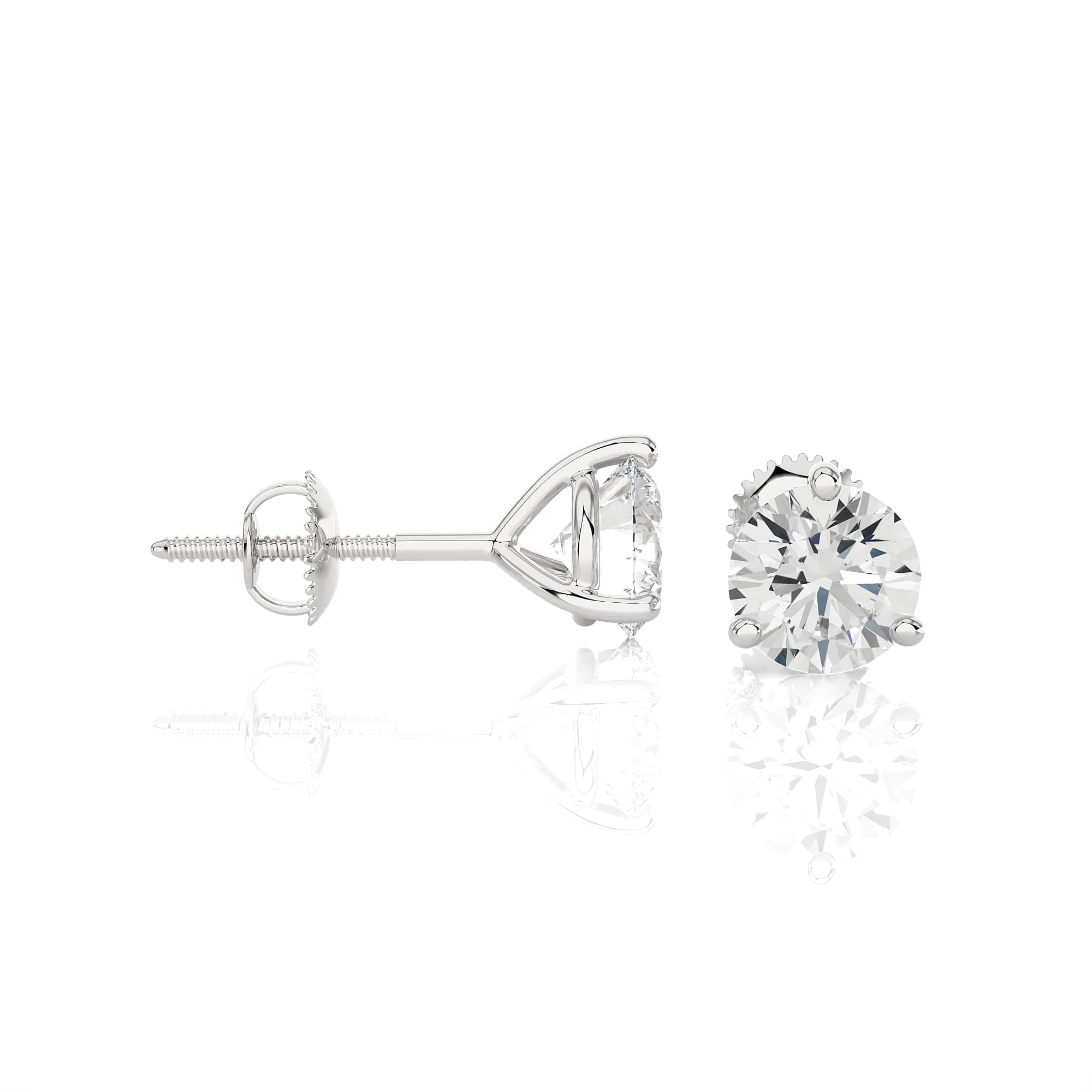
- Martini (3-prong)
- Cone-shaped, like the glass. Sits low and close to the lobe, low profile, very little to snag. The everyday workhorse.
- Basket (4-prong)
- An open cage that lifts the stone slightly and lets light in from the sides. A touch more sparkle and a more classical look, marginally more height.
Neither is better; they suit different lives. Martini for someone who pulls sweaters over their head and wants the earring to disappear into the day. Basket for someone who wants the diamond to sit up and breathe a little. Both are secure when well made.
Backs: screw back versus push back
The back is the part no one photographs and everyone should think about, because it is what keeps the earring on the ear. The two common types are screw backs and push backs (also called friction backs).
- Screw back earrings have a threaded post; the back winds on and grips the thread. They are the most secure option and the right choice for stones you would be sorry to lose, for sleeping in, or for children. The trade-off is that they take a few seconds longer to fasten.
- Push backs slide onto a smooth post and hold by friction. They are quick and comfortable and entirely fine for everyday wear — they simply need an occasional check that they are still snug, as friction loosens with time.
- A locking or guardian-style back is a middle path: faster than a screw back, more secure than a plain friction back.
Buy the diamond you love, then buy the back that lets you stop thinking about it.
Choosing the metal
Every Privosa stud is solid 14k gold — white, yellow, or rose — hallmarked, never plated or filled, so the color is the metal itself and does not wear away. White gold is the most neutral and lets the diamond read coldest and brightest. Yellow gold is warm and traditional and flatters a wide range of skin tones. Rose gold is soft and distinctive and tends to forgive a faintly warm stone.
If the studs are for someone who already wears jewelry, the simplest guide is to match what is already in their ears or on their hands. Most people are consistent — a person in yellow-gold rings rarely wants white-gold studs.
Buying a gift when you don't know her size
Studs are a forgiving gift precisely because there is no ring size to get wrong. When you are unsure, a few rules keep you safe.
- 01Default to a half-carat-each (≈1 ct total) round in the metal she already wears. It is the size most people reach for daily, and it rarely reads as too small or too much.
- 02Choose a round brilliant over a fancy shape. Round is the safest first diamond — it suits everyone and dates least.
- 03Favor a secure back. A locking or screw back removes the worry on a gift you cannot easily replace.
- 04Keep the receipt and note the return window. If the size is not quite right, an exchange is simple.
Knowing how to buy diamond stud earrings comes down to this: choose a well-cut stone in a size you will actually wear, in a setting and back that suit your day, in the metal you already love. Get those right and the earrings recede into ordinary life in the best way — present every morning, worried about never. When you are ready to look, our studs are matched, hallmarked solid 14k gold, and ship complimentary, insured, and signature-required, each with its Certificate of Specification.
Frequently asked
What carat size should I choose for everyday diamond studs?+
For all-day wear, a half-carat in each ear — roughly one carat total — is the classic choice. It is visible without being heavy and suits almost any setting, from work to evening. Quarter-carat pairs are more discreet; a full carat in each ear is a clear statement and a heavier earring. Remember to check whether a listing means carats each or total weight.
Are lab-grown diamond studs real diamonds?+
Yes. A lab-grown diamond is chemically and optically identical to a mined one — it is a genuine diamond, with the same hardness and brilliance. The only difference is origin. We offer both natural and lab-grown studs; choosing lab-grown often lets you move up a size or quality within the same budget. Both come with a Certificate of Specification.
Should I get screw back or push back earrings?+
Screw backs are the most secure — the back threads onto the post — and are best for stones you would hate to lose, for sleeping in, or for children. Push (friction) backs are quicker and comfortable for daily wear, but should be checked occasionally to stay snug. A locking back sits in between: faster than a screw back, more secure than a plain friction back.
What is the difference between a martini and a basket setting?+
A martini setting is a low cone of three prongs that sits close to the lobe with little to snag — the everyday workhorse. A basket setting is an open four-prong cage that lifts the stone slightly and lets in side light for a touch more sparkle and a more classical profile. Both are secure when well made; the choice is about how close to the ear you want the diamond to sit.
Do your diamond studs come with certification?+
Every pair ships with a Certificate of Specification listing carat, color, clarity, cut, and setting. Some pieces feature IGI-graded stones, with the report available on request; where a stone is not independently graded, we specify the details rather than claim a grade. Our concierge can confirm what applies to a particular pair before you buy.